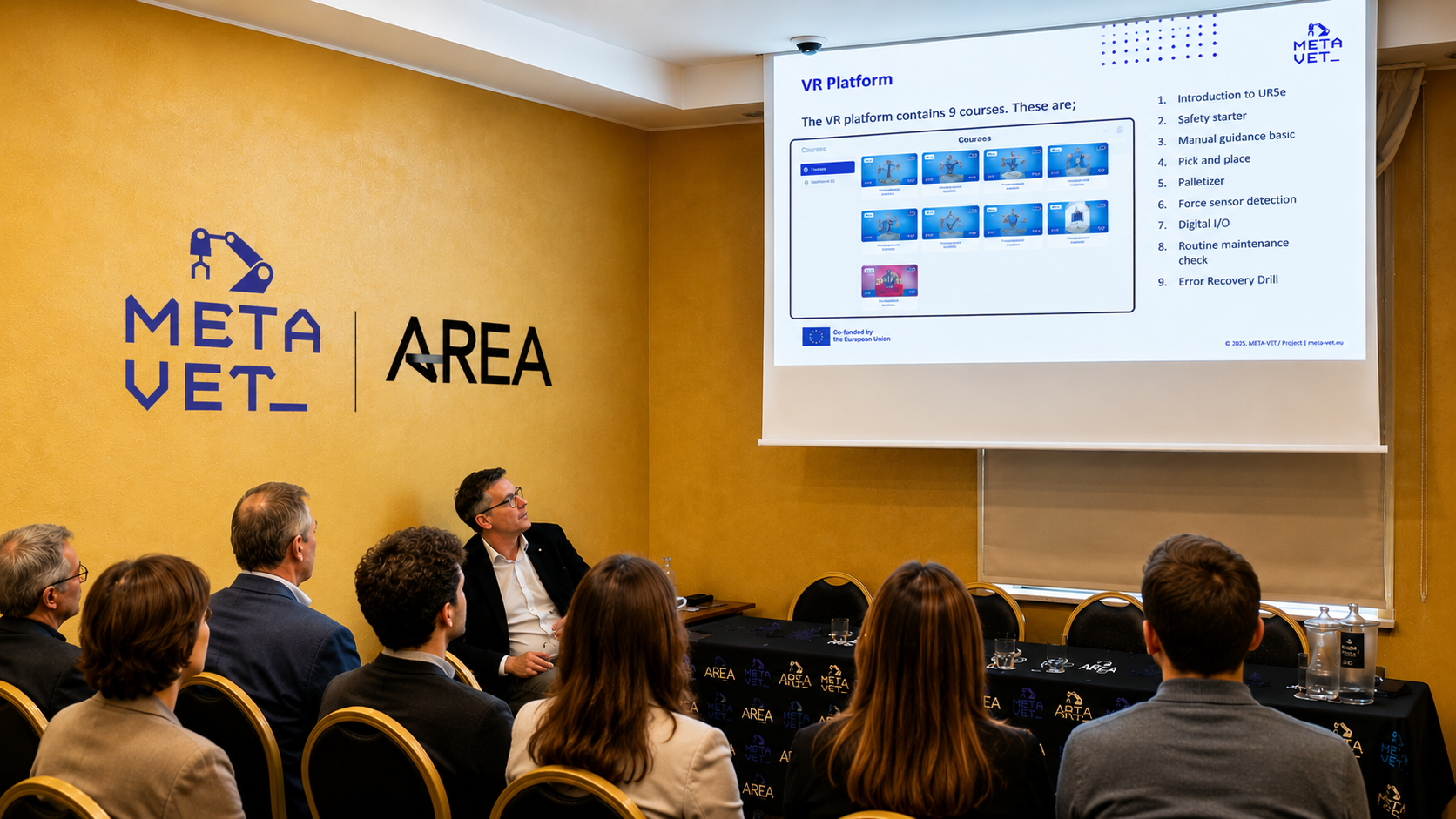
At a recent workshop organised in Udine, Adriano Mauro, AREA Managing Director, presented the results and future developments of MetaVET, an ERASMUS+ project co-funded by the European Commission, showcasing how Virtual Reality (VR) and collaborative robot technologies can transform Technical and Vocational Education and Training (TVET). Developed to support the acquisition of Industry 4.0 digital skills, the initiative provides innovative and accessible training solutions for vocational schools and SMEs through immersive virtual learning environments.
The MetaVET Platform developed by ICEBERG, the project coordinator based in Romania, provides an immersive virtual training ecosystem where teachers and learners interact with intelligent cobots represented by personalised avatars. Through structured, real-time simulations and competency-based training activities, participants can acquire practical skills regardless of their geographical location. One of the platform’s key strengths is its ability to provide real-time feedback from virtual cobots, enabling both teachers and students to learn from mistakes, refine technical competencies, and build confidence through continuous practice in a safe and controlled environment.
The MetaVET initiative originated from the need to strengthen digital and Industry 4.0 skills in vocational education institutions across Bosnia and Herzegovina and Montenegro. The project focused on collaborative robotics as an affordable and flexible automation solution for SMEs, while addressing the challenge of limited access to costly training infrastructure. By leveraging VR technologies, MetaVET created a virtual educational environment where learners can gain hands-on experience even when physical cobots and specialised laboratories are not available.
Building on these results, the concept is now evolving through the CoBotsVETMed Project, which extends the approach to Tunisia and Algeria. This next phase will further refine the platform and enhance its multilingual capabilities, making vocational training more accessible across diverse linguistic and cultural contexts.
A key asset supporting AREA’s digital learning initiatives is the Smart Step e-Learning Platform, a comprehensive digital ecosystem designed to facilitate education, training, capacity building and lifelong learning across multiple sectors. Beyond the delivery of online courses, the platform enables live virtual classrooms, collaborative learning environments, competency-based assessments, and personalised learning pathways.
Smart Step incorporates advanced certification features, including blockchain-based digital certificates and micro-credentials (micro-badges), allowing learners to securely validate and share acquired competencies. The platform also supports interactive content, learner progress monitoring, and community engagement tools, creating a seamless connection between trainers, learners, organisations and employers.
Its flexible architecture allows the integration of emerging technologies such as Virtual Reality simulations, making it particularly valuable for technical training scenarios where access to specialised equipment or infrastructure may be limited. Through Smart Step, AREA provides organisations and educational institutions with a scalable digital environment capable of supporting workforce development, professional upskilling, vocational training, higher education programmes and international capacity-building initiatives.
Looking ahead, the vision continues with future initiatives targeting the Eastern Neighbouring region, including Ukraine, Moldova, and Georgia, where VR-based training environments are expected to support advanced manufacturing skills, including high-precision welding operations performed with collaborative robots.
Commenting on the importance of international cooperation, Adriano Mauro stated:
“AREA create a nexus between mature innovation ecosystems and emerging regions. By bringing together expertise in ICT, Artificial Intelligence, vocational education, business development, and dissemination, we create innovation pathways that transform advanced technologies into practical solutions for skills development and industrial growth. This multidisciplinary approach allows us to support regions at different stages of development while fostering long-term international partnerships.”
The workshop attracted representatives from educational institutions, innovation clusters, industry organisations and civil society, including COMET, TEC4IFVG, ITS Academy Udine and Oikos NGO. Discussions following the presentation highlighted strong interest in the practical applications of the MetaVET and Smart Step ecosystems across different sectors.
Educational institutions expressed interest in exploring the adoption of Virtual Reality-based learning environments to complement existing teaching methodologies and provide access to specialised training resources. Representatives of non-profit organisations identified opportunities to apply immersive technologies to language learning and integration programmes for migrants, while industry stakeholders recognised the potential of VR-enabled simulations and digital credentialing systems to support workforce development, reskilling initiatives and lifelong learning pathways.
The exchange of ideas confirmed that technologies initially developed for Industry 4.0 and vocational training can generate broader societal impact, supporting inclusive education, digital transformation and skills development across diverse learning communities.